Monday, August 16, 2010

Visiting Riga

This weekend, Jessica and I made our way to Riga, the capital of Latvia. Ever since Jessica's Yiddish teacher in Israel shared pictures about his hometown, she's wanted to visit the beautiful and historic city, and Saturday morning we made our way!

We woke up Saturday morning before sunrise to get ready to catch our 6:30 AM bus. There was a cool stillness in the Vilnius air as we walked to the bus station with our two backpacks on our backs, and we passed a few women walking dogs and shopkeepers sweeping their front stoops.

When our bus pulled out at 6:30 on the dot, we were among a half-dozen people in the Delux Lounge of our EuroPass bus. We paid a bit more for some extra legroom - for Jessica, such space doesn't make a difference, but the extra room is a huge deal for me! If we're going to take a 4.5-hour bus ride, it might as well be in comfort!


Our bus cabin

Now, this vacation was certainly the least-planned trip that we've ever taken. Aside from advance purchasing our bus tickets and hotel room, we had virtually no plans or expectations. We didn't have a map, we didn't know anything about Riga, and we only spent a few minutes online looking up sight-seeing suggestions. So, when we arrived, we basically followed the "crowd" toward the Old Town; we found a hotel where we asked for directions to our hotel. Luckily, they were able to provide us with a free guidebook (that became our constant companion) and pointed us on our way. We got lunch at the Sweets Cafe, checked into our hotel (which has the only tub-based shower I've seen in Europe), and hit the town!

Riga is a beautiful city. The Old Town is quite small but packed with gorgeous churches, charming buildings, and historic monuments. We spent a couple hours walking aimlessly through the streets and peeking into shops, stopping for a rest at one of Riga's multiple "beer gardens" (outdoor seating area).


A "beer garden" with shops

Of course, it wouldn't be a vacation without a trip to a museum or two. Taking advantage of our unique circumstances, of course we headed to the National History Museum of Latvia. This museum, situated in the castle that has served as the seat of Latvian leadership for almost 700 years (and the current Presidential residence), traces the history of Latvia from prehistory through the eve of WWII.

Unsurprisingly, Jessica and I haven't spent too much time thinking about Latvian history, so virtually everything that we saw was brand new information! We learned about the evolution of farming techniques in the Baltics, about the change and significance of dress, about the relatively late acceptance of Christianity, about religious art, and about social status through the ages. It was really a greatly informative and well-constructed museum that we highly recommend!


One of several exhibit addenda for blind guests


Latvian Settlers of Catan


Playin
g around in the toy room.


Don't mess with Jexas!

Jessica and I then walked down to the river, which is flanked by parks and gardens. There, we saw several wedding pictures being taken as well as a demonstration by the Latvian Youth Party (about what, we have no idea!). We went on a tour provided by our guidebook (we'd already been to most of the locations) and then met some friends from our program for dinner. A relaxing and enjoyable day!

On Sunday (yesterday), we started with a visit to Riga's only synagogue, the Peitav Shul, an orthodox institution headed by a Chabad Rabbi. We were able to take a look at its beautifully remodeled sanctuary, and as we arrived right after Shacharit services, we were able to converse with one of the congregants who was born in Riga after WWII. He shared with us that there are 7,000 Jews in Latvia, most of them in Riga. However, there's still only one synagogue that attracts about 600 individuals on High Holiday services (obviously much fewer for Shabbat and daily services). The majority of Latvia's Jews, then, are secular. Still, this individual was quite proud of their community, which for the entire duration of Soviet occupation remained alive. He seemed to be less excited about having a Chabad rabbi, but I got the sense that any rabbi was better than no rabbi at all. We were lucky to have such a chatty person (with good English!) to talk with us about today's community; often, we learn about only what was lost.


The Peitav Shul

Next, we walked to the Museum of the Occupation of Latvia. This museum picks up where the national history museum more or less leaves off. It documents Latvia's declaration of independence in 1921 and the occupation of Russia in 1940. The Soviet occupation was a terror on the Latvian people, and the period of summer 1940 to summer 1941 is known as the Year of Terror due to the brutal oppression and unrestrained violence of the Soviets against native Latvians. It's understandable why the Nazis were welcomed as liberators when they invaded in 1941, though it quickly became clear that Germany had Latvian interests in mind no more than did the Soviets.

The Nazis, of course, brought the Holocaust to Latvia, murdering more 70% of Latvia's more than 90,000 Jews (and importing another 25,000 Jews, 20,000 of which were killed). The Holocaust received a few panels in the museum and documented both "saviors" and "collaborators" -- Latvians who worked against or collaborated with the Nazi attempts to erase Europe's Jews. Jessica and I were impressed by the degree to which the Nazis blamed the former Soviet occupation on the Jews, targeting local Latvians' rage against this minority which historically had not had a lot of problems in Latvia.

Of course, we all rejoice that the Nazis didn't triumph in the 40's, but their defeat was still not a liberation for Latvia, for the USSR immediately gobbled up the Baltic states (Lativa, Estonia, and Lithuania). The museum depicts life under Soviet rule, the improvement of conditions after the death of Stalin, and the eventual wresting free of Soviet control in 1991. I was impressed that Iceland was the first country to recognize Latvia's independence, followed soon after by the Soviet Union; the United States, however, did not recognize Lativa's declaration of independence. However, on display was a letter written in English to the Secretary of State of the United States, epxressing Latvia's gratitude toward the US for never recognizing Latvia's assumption into the USSR. America officially recognized the events of 1991 as Latvia's reassertion of independence after 51 years of foreign occupation.

Jessica and I were both very affected by this museum. We have a tendency to think of the "Former Soviet Union" as states that today look a lot like Russia ... just smaller. But this is far from the truth! There have been strong currents of nationalism in the Baltic states for decades, and today's Lativa, Lithuania, and Estonia are all members of the EU and all sound, taste, and feel very different from what we experienced in Russia. We're grateful to have been able to learn so much about Latvia (and Lithuania, during our time in Vilnius of course!).

After our trip to the Museum of the Occupation, Jessica and I got lunch (during a huge thunderstorm) and then went to the Jewish Museum of Riga. Mostly pictures, this museum shows the presence of Jews in Latvia for centuries preceding WWII and documents their enormous depletion during the Holocaust. Simply located in three rooms of the Jewish Community Center, the museum is modest but stark in the message it shares. Unfortunately, there's no information in the museum about today's community, but our visit to Riga's synagogue and a brief conversation with the staffperson at the museum gave us some insight about Riga's Jewish population. There are frequent activities (there were dance classes going on as we left), though the remaining population is dwindling as individuals leave Eastern Europe for other parts of the world. I had a sense that this community is much like Lithuania's, though sadly we didn't have a chance to get a more in-depth feel for its day-to-day life.

On our way out of town, we grabbed our bags from our hotel, bought food at a huge grocery store in a three-story mall in the center of the Old Town, and went to the bus. While we waited, we chatted with a Latvian-born Israeli (in Hebrew) about his three-month visit to Eastern Europe and his Latvian son (in English) about his studies and plans. They then boarded a bus to Moscow(!), and a couple took their place on the bench beside us - two people who had ridden with us from Vilnius! We learned that these two were in Vilnius for the husband's business and were trying to tour around during free weekends. They came to be our conversation buddies on the bus ride home.

As it would happen, these two were originally from India (currently living in Singapore) and were also newlyweds! Theirs was an arranged marriage; they were introduced only six months before the wedding. Naturally, I was brimming with questions about their families, their Hinduism, their wedding, etc., and we talked for hours. Of course, it helped that they were also game fanatics (enjoying Settlers of Catan, Carcassone, and Agricola -- just like us!), so we had plenty to talk about. Too bad they live in Singapore and not the Upper West Side of Manhattan!

We *almost* had a really smooth ride home, but surprisingly, our bus stopped at border control ... and we had forgotten our passports in Vilnius! We were, of course, pretty concerned about what might happened, though I had several plans racing through my head about how we could prove that we were really returning to Lithuania, not sneaking illegally into the country. Fortunately, we didn't need any of them - Jessica explained our situation to the kind-eyed border patrolman, and even if he didn't understand every word, we think he got the gist of our situation. He let us slide without needing to produce any more documentation, and we proceeded home without any more excitement. Believe me, that was more than enough for the both of us!

All in all, our trip was fantastic, and we'd definitely recommend the city to other travelers in the region! We easily could have spent more time there, and we hope to be able to return some day. Now, we're gearing up for our last week in Vilnius before leaving once again ... this time homebound! Here's to a great final week!


Riga's Freedom Monument, erected in 1935

Thursday, August 12, 2010

The Night of the Murdered Poets

Today marks the 58th anniversary of the Night of the Murdered Poets, a brutal and tragic moment in Jewish and Yiddish history, when, after being held in prison and tortured for two years, 15 Yiddish poets and intellectuals who were bearers and leaders of their cultural tradition were falsely charged with capital offenses including being cosmopolitan, nationalistic spies who were working against the Soviet regime, and were executed in the basement of the Lubyanka Prison in Moscow.

Five of those killed were Yiddish poets who represented the hope for the continuation and rebuilding of Yiddish creative and intellectual life in Eastern Europe. All five had been members and leaders of the Jewish Anti-Fascist Committee, which was a propaganda vehicle organized by the Stalinist government to support the Soviet regime during World War II. The committee, made up of Yiddish actors, writers, and cultural activists, reached out to Jewish communities internationally asking them to support the Soviet war effort against Germany. Itsik Fefer (poet) and Solomon Michoels (actor) famously visited England and the US to drum up support for their cause. As World War II progressed and Jewish communities in Eastern Europe were decimated, the Jewish Anti-Fascist committee changed its direction toward rebuilding Jewish communities, and they became symbols of the potential future for Jewish life in Eastern Europe. As Stalin's policies toward minorities shifted from allowing minority cultures to flourish as long as their cultural production was of a specifically Communist nature to eliminating national differences entirely, and as anti-Semitism in the USSR increased with the creation of a Western-leaning Israel, the Jewish Anti-Fascist Committee was disbanded in 1948 and many of its members were arrested and accused of being Zionist spies. Michoels was killed in 1948 in a staged car accident, and others included David Bergelson, Itsik Fefer, Perets Markish, David Hofshteyn, and Leib Kvitko, were arrested, tortured, and, on August 12, 1952, were murdered.

You can read an interesting article written by Joseph Sherman for Midstream Magazine about these murders here. And this is about Paul Robeson's last meeting with Itsik Fefer. And this is a youtube video with a song with lyrics by David Hoffstein.

We commemorated this day by reading the works of these Soviet Yiddish poets in class and in a short memorial ceremony after classes.

Monday, August 9, 2010

the Lithuanian Jewish Community today

Yesterday we heard a talk by Dr. Simon Alpirovich, the director of the Lithuanian Jewish Community, and Simon Gurevich, the professional executive director of the Lithuanian Jewish Community. Dr. Alpirovich is a Holocaust survivor, and Simon Gurevichius is a young man in his 30's with a baby daughter, so they represented different generational perspectives on Jewish life and the development and future of Jewish life in Lithuania. Both of them spoke to us in Yiddish. Dr. Alpirovich described his experiences in Kovno and Vilnius befor the war, and his feelings about how the government has not full-throatedly acknowledged the Holocaust and espouses a false ideology of a symmetrical dual genocide of the Jews at the hands of the Germans and the Lithuanians at the hands of the Soviets, with a belief that most Jews were Communists, and therefore the culprits in the latter genocide. He talked about wanting a fair representation of history from the government, and fair compensation for the property that belonged to the Jewish community (not to individuals but to communal institutions) before the war, so that they can use that compensation to support todays Jews of Lithuania. Simon Gurevichius told us that there are officially, according to government statistics, 3200 Jews in all of Lithuania, but that he suspects the real number to be about 5000, and to include most of the people who in the polls refused to state their nationality. Most of these Jews are in Vilna, but many of them are located in Kovno and in other smaller towns and villages. He told us that the priorities of the community are to make sure that people can live dignified Jewish lives - that is to say, that they have food, clothing, social and psychological services, that antisemitism is countered and fought, and that they can exercise their Jewishness freely; to create an active Jewish identity among Lithuanian Jews who have lived for so long under regimes that wanted Jews to forget what it meant to be Jewish; to preserve heritage, which means both cemetaries and mass murder places and also Jewish culture and Yiddish language; and to become financially self-sufficient (the communioty is now supported largely by Jews abroad). He told us that they have a welfare association that helps 1300 people who are needy, may of whom are Holocaust survivors, but the number of young families who need help is rising due to the economic crisis, and that these include people in 29 cities and towns in Lithuania - the community tries to connect with every Jew in the country, however isolated they may be. They have a kindergarted with 42 Jewish students - they could enroll more but their facility is not large enough to accomodate more children. In Vilna there are 272 kids in the Jewish middle/high school, and there is simply no space for more. They could have as many as 400 students if they had more space, and they hope one day to be able to afford to build another floor onto their school. They have a summer camp for three sessions that serves 600 children, youth movements, student activities, and at their last Limmud (Jewish educational experience/conference) 1300 people came to learn in Volna from all over the Baltic regions. He said that Jews here still face prejudice, but that the largest prejudice recently (because perhaps there are so few Jews) is directed toward Arabs and Africans. He told us that he believes that under the Soviet regime nothing was possible but now, even though they have less knowledge and fewer people than they might have had right after the war, they are in a free country and rebuilding Jewish life is possible. He told us that the people in their 80's might be afraid that any minute a Jew will come back and reclaim their home and property, and that people in their 50's might belive that Jews are captialists and suspicious, but that young people, who are exposed to the internet, to a westernizing and modernizing free state, and so forth, might overcome the history of antisemitism so that Jewish life can flourish here. He says that there are not mnay iptimists in his community, but he counts himself among them and believes profoundly in the possibility for Jewish life in Lithuania, which would be a living monument to those who perished here.
It was really helpful to see what a living community of Jews in Lithuania is today, to hear these hopeful and energetic words from a young person, and to recognize that Lithuania is not only a place of gruesome and horrific death, but a place of rebirth and renewal, and a place of hope. I was impressed and inspired by the efforts of the Lithuanian Jewish Community to regrow itself, despite its tragic history and the challenges it continues to face.

Sunday, August 8, 2010

Kaunas

What a lovely and relaxing weekend! On Saturday morning, we took a train to Kaunas (formerly Kovno), the second largest city in Lithuania. We stayed in a lovely guesthouse, and rather than visiting lots of museums and churches, we spent our time wandering the city's beautiful pedestrian street (the longest in Eastern Europe), enjoying cafes, and admiring the two rivers that converge in Kaunas. We did stop in on one museum on Saturday, the devil museum. This is a three story museum containing about 2,000 devils of many different colors and materials, originating all over the world. There were a variety of perspectives on the devil as a benign trickster and as a dangerous evildoer. I was surprised by how rich the ethnographic and artistic content of this museum actually was - I anticipated something silly, along the lines of a haunted house, but this museum was quite informative and opened up a world of suoerstition, fear, and a sense of personal closenes to mysterious forces that was quite striking.
On Sunday morning we had anticipated meeting our group from the Vilnius Yiddish Institute to do a tour of Jewish Kaunas, but as we waited by the Old Jewish Cemetary, our group never came - we think perhaps this was due to the very strong storm that occured the previous night, which felled many trees along the roads and cut off many power and telephone lines. In any case, we visited the cemetary ourselves (pictures are on the site with the rest of our Vilnius pictures). After World War II, many of the gravestones were torn from this cemetary and used in construction. Toward the back of the cemetary however, one could find fallen over and overgrown tombstones dating back as far as a hundred years. On our way to the train station, we stopped at the Sugihara House, a museum at the former Japanese consulate, where Chiune Sugihara and his family once lived. Chiune Sugihara (1900-1986) was the Japanese Vice Consul to Lithuania in Kaunas for a brief period between 1939 and 1940. Together with the acting Dutch Consul Jan Zwartendijk he saved thousands of Jews over s short three-week period in 1940 by issuing visas against orders to get them out of what was at the time Soviet-occupied Lithuania and away to safety and a new life. The museum was small but quite informative, and we were glad to have the releif of a tale of honor, bravery, and survival in the midst of all of the gruesome death we so often learn about in association with the Holocaust.
We made our way home via train, and are glad to be going back to school this morning!

Friday, August 6, 2010

2nd week and Ghetto tour

We've come to the end of our second week! Our daily experiences this week were much like last week - class 9:30-1:45, discussion groups 2:00-3:00, afternoon programs 4:30-6:00, and free evenings. We've been real socialites this week - we went out with people every single day! It's nice not only to be learning a language but to be meeting and making friends with others from around the world who are doing the same.

I was surprised at how many non-Jews are enrolled in this program. Based on the conversations I've had, I'd say that at least half of the students aren't Jewish. I think it's wonderful that there are non-Jews who find Jewish studies so valuable and interesting that they'd travel to Vilnius for a month, and they've certainly enriched my own perspective on what Yiddish is and what its importance is. Yiddish isn't a language accessible by and related to only Jews - it's a cultural key and symbol to a rich and diverse history/sociology/philology/religion/anthropology. Yiddish has personal significance to me as well as significance--personal and otherwise--to many Jews and non-Jews around the world. My time here is teaching me not only about Yiddish itself but also about the people who love Yiddish and who want to incorporate it into their lives. I'm grateful to have met this diverse array of individuals who have shared their passions with me and with the program, and I celebrate the multivocality of the group that we've created here in Vilnius.

Of course, Jewishness cannot be separated from Yiddish (in Yiddish, "yiddish" means "Jewish"). Naturally, then, the cultural programming is focused on Jewish culture, especially Vilna Jewish culture. As such, on Friday, Jessica and I took separate "Ghetto tours," one offered in English and one in Yiddish. On my English tour, Rochel showed us WWI pictures of Vilnius and compared them to the current city. She boldly took us into a hotel, a restaurant, and a conservatory to point out the differences between the 40s and today. She shared stories about the Great Synagogue, about the building where the Judenrat held council, and the intersection from which tens of thousands and thousands of people were transported to Ponar. I've been walking these streets for two weeks and reading about them in From that Place and Time, and going on this tour further brought to life the incredible power of the events that transpired here.

I think American Jews (myself included) think a lot about the Holocaust even though most American Jews have no close family who were in Europe during WWII. Being here, though, makes an amazing difference. I can close my eyes and almost hear the echoes of peddlers crowded into these narrow streets, and I can just barely begin to imagine the fear of the Vilna Jews as their life and lives were robbed from them. (When the war made its way to Vilna, the city was about 50% Jewish (80,000 people). Now, there are only a few thousand Jews remaining - less than 1%.) As I learn more about the rich and prolific history of Vilna and its heroes--including the Vilna Gaon, Jascha Heifetz, Max Weinreich, and Abraham Sutzkever--I feel more weightily the loss in this area and all across Europe. At the same time, I celebrate the accomplishments and culture that eastern European Jews cultivated over a thousand years, focusing not only on their destruction. This mixture of vibrant life and tragic death swirls through the air during my time here and gives complex meaning to the time I'm spending in Vilnius.

I'm delighted and proud to be studying Yiddish in the Jerusalem of Lithuania, and I look forward to carrying what I learn back to America. I have no doubt that this experience will have a significant impact on my personal and communal Jewish identity, and I can't wait to see what the next two weeks have in store!

Sunday, August 1, 2010

Field Trip: Cemetary, Panar Murder Site, Partisan Camp

Today, Fania took us on a day-long field trip that was powerful and sobering. Fania is an energetic speaker, a devoted educator about the Holocaust, with a deep sense of obligation to the millions who were murdered during the war, and especially the history of Vilna during the war. She has a generous and optomistic outlook despite all that she has seen and experienced in her life, and learning from her, watching her talk for hours on end, recalling facts and names and places, telling stories both horrifying and heartwarming with a singleness of purpose and a strength of spirit was truly inspiring.

Fania was born and raised in Vilna, she attended a Yiddish school. Her father was an instructor for ORT, and he was taken to Estonia and killed during the war. Her mother was sent to Riga in a large group of women. All of the women over the age of 35 were sent on a boat into the sea, and the boat was sunk. The rest of her father's side of the family was killed in Panar, while her mother's side of the family, who had emigrated to Israel before the war, survived. Fania survived in the ghetto and joined the Faraynikte Partisaner Organizatzia (FPO, United Partisan Organization) at the age of 17. She served in that organization, living in the forest and fighting to contribute to the downfall of the Nazis. After the war, she worked in statistics, and she now works for the commitee for Holocaust survivors in Lithuania, which has more than 100 members, and works at the Vilnius Institute as the librarian. She herself is responsible for having started the library at the Institute, all of the books were gifts.

The first place that Fania brought us to was to the Jewish cemitary in the Seskine district. There were three Jewish cemetaries in Vilna before the war. The oldest and largest one was located accross the Neris River from the central part of the city. In it, many famous rabbis were buried and it was a veritable historical record for Jewish Vilna. The tsarist authorities closed the cemetary in 1831, and the Soviet government later destroyed the cemetary and built a sports complex in its place, as well as some housing units. The building was finally stopped due to protests, but not until the damage had already been done. The next cemetary was active from 1848 until 1943. In the 1960's it was destroyed by the Soviet authorities and tombstones were used for staircases and stoops around the city. The third cemetary, the one we visited, contains about 6,500 Jewish graves. We visited several graves and monuments in the cemetary. The first were symbolic gravestones for some of the leaders of the partisan movement, whose bodies are not located at the cemetary itself. We saw a tombstone for Itsik Wittenberg, the leader of the Vilna FPO, as well as one three graves for the three partisans who were caught sneaking out of the ghetto through the sewage system and hanged. Deeper in the cemetary, there is a monument we did not have a chance to see, for 400 children who were taken by the Nazis and bled dry so that the Nazis could use their blood - the bodies were then discarded. We did see a monument for Jewish teachers, which Fania was instrumental in creating, both because she believes that teachers were essential in keeping up the morale of the community in the ghetto, and because her father was a teacher. There are graves in the cemetary as well for those Jewswho died while in the ghetto. Fania marveled that while 70,000 people were thrown into mass graves in Panar, the Germans chose to bury these people who died in the ghetto each in their own grave with a tombstone. Every year on May 8th, the Vilna Jewish Community gathers at these graves to celebrate the liberation of Vilna. Fania said that this is a holy day, children come from the schools, and everyone sings the partisan hymn. In the cemetary, we also saw the grave of the Vilna Gaon and of the Ger Tseddik. Their remains were btought to this cemetary when the other cemetary was destroyed, but many remains of rabbis and other historical figures were not saved.

We next went to Ponar, and listened to Fania speak of the shocking and unthinkable murders that occured in that terrible place. Before the war, the Soviets dug pits in Ponar, located 6.2 miles from Vilna, where they intended to store fuel storage tanks, but they evacuated before they ever used the pits for this purpose. The Nazis used the site as a death factory - they killed people here every day starting about a week after they first entered Vilna, until the end of the war. At first, they recorded names, but shortly after beginning the killings, they stopped keeping records. We do have documents about what happened in Ponar, though. A Polish journalist lived nearby and kept a journal recording how many people were murdered, and who was killing them. People were brought here, told to disrobe, shot in the head, and thrown into pits. They were covered with lime, and then new bodies were layered on top. Their clothing was sold for profit. A Polish journalist bicycling through a train tunnel saw a beautiful girl on a train heading toward Ponar. He wrote that he later saw German soldiers playing football with her head. The Nazis used Ponar not only as a site to kill the Jews of Vilna but also brought in people from surrounding towns. The Jews of Vilna were forced to march here on foot, along a winding old road. Jews from other places came by busses and trains, and some of the last people to be killed were gassed on the trains heading to Ponar. The victims were told that they were going on the trains heading to work, and because that had been their prior experience of what happens during a war, they believed that they were going to Kovno for forced labor, and didn't suspect that they would be systematically killed. Not all of the victims at Ponar were Jewish - 100,000 people were murdered in Ponar, 70,000 of them were Jews. Polish priests were murdered here, as well as Polish professors, and any person suspected of opposition to the German authorities. After the war, the Jews who survived came here and erected a monument, which the Soviet authorities dismantled. In Soviet times, the signs posted at the site said only that the Germans killed Soviet citizens here, and made no specific mention of Jews. The current sign, which was displayed after a long-fought battle, is written in Hebrew, Yiddish, Lithuanian, and Russian, and states the numbers of Jews and non-Jews murdered, and that the killing was done by the Nazis and their local collaborators. There are individual momuments to the Poles, Lithuanians, and Jews killed here - we had the opportunity to see these monuments, and we were reminded that as we walked, although we were on a paved path, we could very well be walking over mass graves. We saw a monument to the last Jews who were killed in Ponar, on the 5th of July, 1944, ten days before Vilna was liberated - these were Jews who had been working as slaves in Nazi workshops. While we were at this monument, Fania told us about a German officer who saved many Jewish lives by trying to treat Jews as human beings, even from his position of authority. He was overseeing these Nazi workshops, though he was not affiliated with the SS, and there was little oversight of him and his work. When he was told that the SS would take over the workshop, he warned the Jews working there, and several of them were able to flee before the SS arrived. Fania told us that when she was in the ghetto they didn't know that the Ponar death factory existed. They thought that people were being sent on trains to work, as they had been during the first World War. When the first survivor of Ponar came to the ghetto, shot through and covered in blood, and was taken to the ghetto hospital and hidden, people thought that she was crazy and did not believe her that unarmed people were being gathered en masse to be shot and killed. Fania took us to one of the open pits, now covered with grass and wildflowers, with butterflies darting around it. The partisans referred to the grave as the "child grave" because when they found it, they found a lot of children's parephanalia around it - shoes, clothes, etc. Fania told us about one child who survived the murders in Ponar because the shooters somehow missed the target and he was thrown into the pit alive. He managed to crawl out, covered in blood, and he went to a town where the locals had pity on him, washed and clothed him, and brought him to the partisans. He is still living now in Tel Aviv. There are currently seven open pits in Ponar, but many more were covered over. In December of 1943, when the Nazis knew that they were going to lose, they wanted to get rid of the evidence so there would be no sign of what they had done. They brought 84 laborers from workshops, and four women to cook for them over an open pit, and had them perform the gruesome work of destroying the evidence. These people were forced to chop wood, dig up the mass gravs, make piles of corpses and wood stacked together, and burn them. They had a quota of how much to burn each day. If the bones didn't burn, tey would hit them with a hammer until they were pulverized. Then they would put the ashes through a seive in case they could find a gold tooth or a ring. One of the workers, named Dogim, while digging in Ponar, found the corpses of his own wife and children, and had to burn them. If one of the workers got sick, he was thrown onto the pile to be burnt. The workers knew that they wouldn't be allowed to live after this work, they were working in a sealed place that even some Germans weren't allowed in and they knew they would be killed so Fthat they could not testify to what they had seen. They devised an escape plan so that the world wiuld know what had happened in Ponar. They decided to tunnel out. In their first tunnel attempt they ran right into a pit of bodies and had to start aghain. They dug using plates and spoons, carrying the earth out in their pockets so that they could scatter it where it would not be noticed. They made a cabinet where they would store their clothes, and they dug the entrance to the tunnel underneath the cabinet. Their feet were chained together and they had to use a file to saw through the chain sin order to make their escape. Only 12 of them survived the escape. They were easily caught because reeked so terribly of death that the dogs could find them easily. Those who survived hid in cow dung being used as fertilizer, which masked their odor so the dogs could not find time. The Nazis sent out radio reports that criminals had escaped and said that they would pay a reward of 100,000 marks for anyone who found one of them, which illustrates how desperately the Nazis wanted to hide what they had done. The partisans went to meet the esaped workers and their smell was so terrible that they threw up when they encountered them. The escaped workers had to bathe in the partisan camp ever day. Some did not survive the ordeal. Some of them later gave very detailed testimony, and some of them were witnesses in a trial in Riga about people who were killed during the war in Baltic countries. One of the survivors gave reportage about his experiences in Ponar while standing at the place where Fania was speaking to us, and it was directly from him that she learned all that she told us. Once a year at the anniversary of their escape, people gather to memorialize them and their bravery and the horror they faced. No witnesses are alive from this ordeal any longer, but their testimony is accessible and speaks on for them. Fania told us about the official events that occur in Ponar several times a year, both within the Jewish community and with officials and dignitaries of Lithuania and other nations. Fania herself often leads tours in Ponar, and she says that it is her obligation, as long as her feet can still carry her, that she must speak for the people who cannot rise from the dead and speak for themselves.

We next went to the Rudnitsky woods, where Fania lived for about a year as a partisan. It is about 40 Kilometers from Vilna, and there were partisan bases throughout these woods, which were at the time quite swampy. Fania told us that three months after the Vilna ghetto was formed, the United Partisan Organization begun, uniting the heads of many political parties who had been starkly opposed during the prewar years. They created two divisions. They had first to figure out how to get weapons and to decide if they would fight from the ghetto iteself or in the woods. They decided that it was unrealistic to resist from the narrow streets of the ghetto and decided to go into the farest. Jews who were dragooned into working in factories, revamping old World War I weapons, would smuggle in parts to make guns in the ghetto. They smuggled in gunpowder and explosives, wicks and lamps for making molotov cocktails. Chimney sweeps were especially helpful in this effort because they were able to leav the bounds of the ghetto, so they carried a false bottom case with their tools on the top and smuggled items underneath. People invented all sorts of means to smuggle in resources, wrapping themselves in bandages with weapons underneath, or smuggling them through the sewage system (Shmuel Kaplinsky was a civil engineer who knew the sewage system through and through and was essential to the Vilna resistance.) Some guns were bought from Lithuanians that partisans had relationships with, and others were stolen from Nazis. Wittenberg, the commander of the FPO, was reported to German authorities for insurgent activity and was called before the Judenrat and told to turn himself over to the Germans. He hid from the Judenrat, dressing himself as a woman, and was able to make his way into the woods. The partisans knew that they had to leave the ghetto in part because they felt that the population of the ghetto would not support their work because they didn't want to risk their lives, not understanding the scope of the danger they faced. The slogan of the partisans was "Lisa is calling" - Lisa was the name of one of the partisans who was killed very early on. The first division of the partisans went to Belorussia, and the second group, Fania's group, went to the forest near Vilna, where there were already other organized partisan groups. Fania was chosen to be a messenger between the ghetto and the partisans, and received formal training for this. This was a job specifically for women, because it was harder for Germans to know that they were Jewish. Fania left the ghetto for good with a friend on a day when she knew someone who had permission to leave, so they could sneak out of the gate behind him. They went down one street, saw German officers, and turned around and went another way. As they were walking, they saw German convoys and trucks heading toward the ghetto. They made their way into the forest. On their way they got lost, and had to spend the very rainy night in the forest. They cme to a village and asked for directions, saying that they were going to their aunt's house to help did potatoes. As they headed on their way, they saw German soldiers, but just kept on going, rather than turning around and causing suspicion. They met a young man who they told this potato story to, and he, understanding who they really were, brought them into the forest and said they should wait there and trust him. Fania marveled that after escaping from the ghetto, she so easily left her life in a stranger's hands. But sure enough, in the morning the young man brought them bread and milk and walking sticks and hed them on the way toward the partisans. He then left them, saying that he was afraid that if the partisans saw him, they might kill him. As they started walking toward the partisans, they were excited and started singing, and someone rushed toward them and told them to halt and asked for the password. They were so nervous that all they could do was giggle, and they were held by the partisans in an area for suspects. While they were waiting there, they saw a friend, who told them that the ghetto had been liquidated the day they left. Fania showed us around the camp - at first they lived in little wooden structures like sukkot, but then they had to prepare for the winter and they made more permanent structures, which still stand and we were able to go into. They survived a forest fire and a terrible storm during which the trees fell like matchsticks. They had a "hospital" run by a former medical student, a bath, and a kitchen area (a campfire). Men and women fighters lived there, as well as people who were night fighteres but who had managed to escape and needed a place to hide. There were four Jewish partisan groups in the forest, among many non-Jewish groups, and among the Jewish groups not everone was Jewish - sometimes they would find other people who would join them. Fania told us about a Dutch man named Hank who had been fored to dig peat for the Germans for fuel and escaped and joined the partisans. He worked in the workshop as a mechanic, fixing weapons. The partisans shared a sense of unity of purpose, and they all got along. Fania met her husband in the partisan camp, and now has three daughters and lots of grandchildren and great-grandchildren. A number of couples were formed in the partisan camps - they were people who had lost everything and everyone, and they clung to each other. Life was very difficult - they lived on rye flour with hot water and occasional fat from sheep, and there was barely enough to feed everyone. But they lived with an elevated mood - they were young and resilient, and they would sing together and rais each other's spirits. And they fought. They were fighting for thier dignity and their humanity, and to contribute to the defeat of Hitler. They were extraordinarily brave, and it was an honor to hear Fania's story and to see the place where she lived and fought first-hand.

It was an exhausting and emotional day, but a very important one. We will post pictures here and invite you to look at them. Thank you for the opportunity to share some of what we have heard and seen.

Saturday, July 31, 2010

Shabbat

We arrived in Vilnius last Friday afternoon and made a modest Shabbat for just the two of us. Now, after a full week, we had a chance to expand our Shabbat experience - and we've had a really terrific time!

On Friday afternoon, Jessica went on a group tour of the Vilna Gaon Jewish State Museum, which highlights Jewish life in Vilnius before World War II and during the Holocaust. I toured this museum on Tuesday in English; Jessica's tour was given by an 88-year-old former partisan named Fania Brantsovskaya. Her tour was incredibly moving as Fania shared personal stories about individuals depicted in photographs documenting the atrocities of the Shoah. The first picture one sees when walking into the museum is a large family portrait - Fania shared that only she and her cousin survived the war. Now, Fania passes her story on to new generations of students and rememberers.

Fortunately, we were able to lighten the mood after this heavy experience. Jessica and I collaborated on making a delicious Shabbat dinner (perfect challahs, caprese salad, spinach salad, bean pie, and watermelon for dessert), to which we invited our two friends from New York, Julie and Bengy. The four of us then proceeded to the Shabbes tisch (table), where members of our program gathered to share snacks and sing Yiddish songs in celebration of Shabbat. Two groups of students and teachers led the singing, almost entirely in Yiddish, and though not everyone understood what was going on, everyone seemed to love being with one another outside the classroom with nothing but good company and warm food to occupy us.

Today (Saturday), Jessica and I went to the Choral Synagogue. Built in 1903, this is the only one (out of more than 100) synagogues in Vilnius still standing, having survived both WWII and Soviet governorship. The community is, as it has always been, orthodox in its inclination, so Jessica and I were not able to sit together during services (as was expected). Though separated, we were warmly welcomed by those around us, and the beautiful singing of the service leaders conducted us through a service that is familiar to me even across boundaries of distance and ideology.

Congregants spoke to one another primarily in Yiddish, and when one congregant asked me Bistu Kohen, Levi... I knew to answer Yisroel. I was invited to give the fourth Torah blessing, which I tried my best to deliver with the Ashkenazic pronunciation of Hebrew that is customary in this conversation. The other men at the Torah scroll were warm and supportive, and I felt more comfortable than ever before in an orthodox congregation.

Unfortunately, my comfort and the comfort of those around me was disrupted by an apparently ultra-orthodox man who (it seems to us) makes a point of attending this synagogue even though it's not "his" community. After the sermon, which was delivered in Yiddish, this black-suited, long-bearded man ascended the bima and was immediately met with angry shouts to sit back down. The man ignored them and at the top of his voice, welcomed the visitors in the congregation to Vilnius (the only part of what he said that I understood as he was saying it). He then proceeded (as Jessica translated for me later) to berate the community for its poor observance.

His tirade became more and more emphatic, and at one point, a member of the congregation started arguing with him. After a couple minutes, most of the men walked out of the sanctuary; not long after, this man took his leave from the bima (though he remained in the sanctuary, continuing as he had the whole service to speak to people rudely using his "outside voice"). It was a real shame that he brought his bitterness and judgment to this community on Shabbat. Though he lamented the poor observance being displayed before visitors, truly he was the one being unwelcoming to foreigners.

The community soon recovered from its shock and anger, concluding the service as normal. Congregants bid one another a gut Shabbes and departed, turning off lights and closing down the windows as they left. (This, of course, caused the vociferous interloper to loudly declaim the congregants' poor observance on his way out of the synagogue.) Jessica and I said our good-byes and came home to enjoy once again last night's dinner food.

In the afternoon, Jessica and I visited two Vilnius sites. First, we traveled to Gediminas' Tower, whose history stretches back to the beginning of the fifteenth century. From the top of this old fortress, we had a great 360° view of Vilnius; we could see the huge cathedrals and small houses, the centuries-old Old City and the stark buildings from the Communist Era, the busy skyscrapers and the peaceful forest. It was amazing to have such a perspective on where we live, reminding us of how little we've seen in the week that we've been here.

We left the castle and walked through the business district of the city, replete with tall hotels, taller banks, a shopping mall and a casino! We visited the National Gallery of Art, which contained twelve large rooms full of an array of works created by Lithuanian artists over the past hundred years or so. Highlighted currently were several exhibits of artwork involving women, accompanied by explanatory signs that interpreted the use of women in ancient art, Soviet propaganda, and modern media. The art was really terrific, and there was so much that we couldn't see it all before becoming too exhausted to stay.

On our way home, we passed a small area near the river that seems to be a mini-fair. There were bumper cars and bumper boats, a huge bouncy-castle, several beach volleyball courts, and a skateboarding/biking plaza. Even better (for us), we stumbled upon Mano Guru, a salad restaurant with 1/3 of its meals vegetarian friendly! I enjoyed a tall glass of "cowberry"-pear juice, while Jessica drank some interesting hot tea, and we dined on delicious salads before topping off the meal with a piece of chocolate cake with cherries and vanilla ice cream (all for the equivalent of $15). What a find!

Tomorrow, we have a field trip with the program that will take us into the heart of Holocaust remembrance. We anticipate that the day will be very hard, though we're going to try to relate what we experience here on the blog. For now, though, we're still appreciating the beauty of our Shabbat, and we're looking forward to another expanding and engaging week of courses!

Wednesday, July 28, 2010

Yesterday's Lecture

Yesterday afternoon, we had the opportunity to hear Fira Bramson, the director emeritus of Judaica at the Lithuanian National Library, speak about the destruction and reconstruction of Jewish libraries in Vilnius. She spoke in Yiddish, and one of the professors from the program translated her words into English.
Before the war, Jews made up a third of Vilnius's population and Vilnius was a major center for publishing and printing books, including the religious books that were used throughout Eastern Europe. By the 1820's Rohm's publishing house was already publishing secular literature in the form of booklets of stories for women. Kletske press, one of the largest Jewish presses in Europe, published translations of world literature into Yiddish, children's literature, and textbooks, as well as classic Yiddish writers and new up-and-coming writers, including the group of writers known as Yung Vilna. The Tomer publishing house published scientific works. Later, Warsaw became the center of publishing but the printing itself continued to happen in Vilna. Fira mentioned that the Lithuanian National Library has selections from these scientific volumes, which were selected not by people but by the mere fact of their survival during the war, just like the people who remained after the war. There were four major Jewish libraries in Vilna before the war, the largest of which contained 15,000 volumes. The Yivo Institute for Jewish Studies was begun in Vilna, first out of the apartment of its founder, Max Weinreich and later in a new apartment, and finally, for 13 years, in its own building, which was built with funds raised from Jews around the world. In 1944 the building was destroyed by a bomb. Yivo was a major factor in the Jewish world, which connected itself to the people and collected important artifacts, some of which were saved and sent to Yivo when it relocated to New York.
When Jews were forced to enter the ghetto, many of them smuggled in their books, so that they managed to bring 1000 books into the ghetto and start a library there. The library was a cultural center for the ghetto. In 1941 the gestapo sent all of the books in Vilna to the Yivo building to be sorted - the most important were to be sent Frankfurt Germany's Nazi Institute for the Research into the Jewish Question. Seventy percent of the books were to be disposed of. The famous "paper brigade," a work group of twelve poets and writers, that was forced to sort through this literature, hid as much of it as they could, smuggling books into the ghetto, where they were stored in private homes, cellars, and the ghetto library.
After the war, the partisans who had left the ghetto through the sewage system came back to find the books and gather them into an exhibit on the cultural life and preservation of the human spirit in the ghetto. The Soviet government was not interested in displaying the exhibit and sent the materials from it to various institutes - it was never reassembled. During the Soviet years, Jewish life and expression was suppressed, and very little could be done with all of the Jewish books and materials that had been saved, They sat in a church, and in 1989, Fira and others were finally able to access the material and sort through it, finding papers from Yivo archives, newspapers, and kilos and kilos of books. Copies of some of this material was sent to Yivo in New York, but much of it can only be found in Vilnius. The catalogue for the library's holdings is undergoing digitization, so that the world will be able to see that in Vilnius they have 10,000 first editions, and copies of newspapers from the 1920's and 1930's that don't exist anywhere else.
Fira said that the fact that these materials were saved through all of the traumatic events of the 20th century, and the fact that when people could finally access them there were still people around who understood the significance of the materials and could read them is a miracle.
It was an honor to hear from a Jewish activist so dedicated to preserving the written material, the words and writings that bear witness to a Jewish world that was almost completely lost. In her retirement, Fira wrote a book of essays and thoughts about her work with the library, which was published in Lithuanian and Yiddish - I have a copy of it now and look forward to reading it!
This interesting newspaper article from 1996 discusses the precarious position of the materials from the library not so long ago.

Tuesday, July 27, 2010

Second Day of Class

In the Vilnius summer Yiddish program, students are divided into four levels, and each level has language classes with two different teachers, with a generous coffee break (coffee and tea provided) between them. In the afternoon there are study sessions and supplemental cultural educational activities, and every Sunday there is a field trip.

My class, level 4, consists of eleven students, including myself. Four are young female graduate students from the US, Poland, France, and Lithuania, two are middle aged women who work for YIVO, the Jewish scholarship institute, in Buenos Aires, two are middle aged women from Israel with some previous involvement with Beit Sholem Aleichem, a Yiddish organization in Tel Aviv, one is an actress and translator from Vancouver, one is a professor of Dutch language who teaches in Helsinki, Finland, and one is a man born in Czcheckloslovakia, who lives in the Netherlands and is engaged in the process of formal Orthodox conversion to Judaism. We are a geographically and experientially diverse class, but our Yiddish is roughly on the same level, so we are able to have interestig conversations about the poetry and literature that we read together.

Our first class is taught by Abraham Lichtenbaum, who is the executive director of YIVO in Buenos Aires. He is a funny and dynamic teacher, patient, provocative, and insistent on class discussion rather than lecture. In his class we are reading The Dybbuk, perhaps the most famous play ever written in Yiddish. It was written in 1914 by Sh. Ansky, a folklorist who went on expeditions to research the way of life and culture of Jewish communities in Eastern Europe. It is a passionate, mystical, spooky piece, and I am really looking forward to exploring it with this class. Yesterday Professor Lichtenbaum lectured us on Jewish folk practices and superstitions to prepare us for the piece, and today we will start talking about the play itself.

Our second class is taught by Dov Ber Kerler, who teaches at Indiana University. He has high expectations for our class, speaking Yiddish very fast and antipating that we will read and write quite a lot over the course of the month. He begins class each day with a poem that we listen to on his computer so that we can hear the poet's actual voice. Then, we go on to read and discuss a work of literature. Right now we are reading Yaknehoz, a comedy about the absurdity and vulgarity of Jews involved in the stock exchange in Odessa. The print is small, and Sholem Aleichem was known for his nuanced representation of the spoken word, so that the text was certainly not constructed for students but for people who could pick up on the slavic expressions and cultural references. Nevertheless, from what I can understand of the play, it is a doozie!

It appears that each week we will write two short essays for Professer Lichtenbaum and two longer essays for Professor Kerler, and we will take turns giving presentations as well. It does seem manageable though, as we have afternoons and evenings to ourselves to prepare the homework.

On the first day of class we read a poem which I really enjoyed and thought was interesting, so I'll share it with you here:

To Be a Jew

To be a Jew means always running after God,
Even if you are turning away;
Sitting and waiting for an unknown day
(Even if you are a non-believer)
When you will hear the sound of the Messiah's shofar

To be a Jew means not being able to get away from God
Even if you want to;
Not being able to stop saying prayers
Even after all the prayers have been said,
Even after all of the excuses have been made.

-Aaron Zeitlin


And one more, for good measure:

The Jewish People

Zionists want all of the Jews,
Communists want all of the Jews,
Socialists want all of the Jews,
Anarchists want all of the Jews.

Everyone - wants all of the Jews.
The people says:
Slow down...

Just as the world is - so am I,
Says the people.
And how is the world? This is how the world is.

A bit of earth, a bit of water,
A bit of wind, a bit of fire,
The rest - sand.

And so am I - says the people
Like the world.

A bit of Zionism,
A touch of Communism
A spray of Socialism
A breath of Anarchism
The rest - sand.

Made up of all these little pieces - says the people
Just like the world - so am I.

What a shame it would be if the world was made
Of only fire, only water,
Only earth, only wind.

A bit of Yiddish, a bit of Hebrew,
A bit of religion, as bit of secularism,
The rest - sand.

The Jewish people is as old as the world,
And as wise as the world.

Monday, July 26, 2010

First day of class

Today was our first day of classes at the Yiddish Institute - certainly a change of pace from our honeymoon in Italy! There are 12 students in my Yiddish 1 class and about 10 in Jessica's Yiddish 4 class, and these students are from all around the world (England, Canada, Israel, Germany, Lithuania, Poland, etc.). In Yiddish 1, we reviewed the alphabet (alef-beis) and in Yiddish 4, Jessica's class went over several Yiddish poems (you can see the difference, can't you?). My homework: Write three sentences. Jessica's homework: Write three pages (though she has one extra day). Let's just say I'm glad I'm in my own class!

This afternoon, we watched a film called Ivan and Abraham, which depicted Jewish-Polish relations in the 1930s. I thought the acting was a bit flat, but the imagery and character development were fascinating, giving a taste of pre-WWII life for Jews and non-Jews alike (or at least the retrospective view of that life from the early 1990s). This is the first of several films that we'll be viewing, and I'm as excited to see the content as to learn about the perspective of the filmmakers that gave birth to these stories. More on those as we get to them!

I'm very impressed by the other students that I've met. Most I've spoken with do not identify as Jewish but are nonetheless interested in studying Jewish language, culture, and history. Students have come for any number of reasons with such a variety of stories - I'm endlessly interested to learn each person's story and to see the world though his or her eyes. I'm so looking forward to getting to know everyone better!

Sunday, July 25, 2010

Day One of the Yiddish Program

This morning we made our way through the former Jewish quarter of Vilnius, down Zydo Gavte (Jewish Street) to Vilnius University, where we entered the Vilnius Yiddish Institute to register for the program. We met friends of ours from New York there, Julie and Benjy, encountered a friend of mine from my internship at the National Yiddish Book Center, and set about to chatting and becoming aquainted with folks. We were impressed by the age and geographical range of the participants - we appear to be among the younger students, though there are a healthy number of students about our age, and the students come from 18 different countries including Israel, Finland, Italy, Belgium, Holland, Lithuania, Britain, and Canada. After registering, we took a walk and ended up in a coffee shop to read our books, where I ordered a magnificent coffee with melted chocolate on the bottom. The program reconvened at a restaurant close to the University, where we heard brief opening remarks reminding us of the weighty joy that the organizers feel in continuing Yiddish in the city that came to symbolize the language and its literature and scholarship. We heard from organizors as well as some members of the Lithuanian Jewish community. Also, our friend Benjy, a talented Yiddish musician who will be leading music sessions during the program performed some songs about food. Then, we ate some delicious food while talking to participants in the program, all of whom seem very friendly and interesting - I think the relationships we form here with other participants will be highlites of the experience. On our walk home we stopped in a museum of contemporary art, where we saw work from the Fluxus Movement, as well as some terrific international artwork, including a jarring exhibit on the Virginia Tech shootings, which I was surprised to be viewing so far away from home.
Tomorrow morning we begin classes at 9:30 AM - can't wait to tell you all about them.
In the meantime, check out some pictures of our visit here.

Saturday, July 24, 2010

Rebuilding on the remnants of the past

Today, I started a new book recommended to us by a rabbi who works at HUC in Jerusalem. The book is called From that Place and Time, and it's a memoir about the Vilna Ghetto. Wikipedia's opening paragraph about the ghetto provides a good summary of the significance of this area:

The Vilna Ghetto, Wilno Ghetto or Vilnius Ghetto was a Jewish ghetto established by Nazi Germany in the city of Vilnius, during the Holocaust in World War II. During roughly two years of its existence, starvation, disease, street executions, maltreatment and deportations to concentration camps and extermination camps reduced the population of the ghetto from an estimated 40,000 to zero. Only several hundred people managed to survive, mostly by hiding in the forests surrounding the town, joining the Soviet partisans or finding shelter among sympathetic locals.

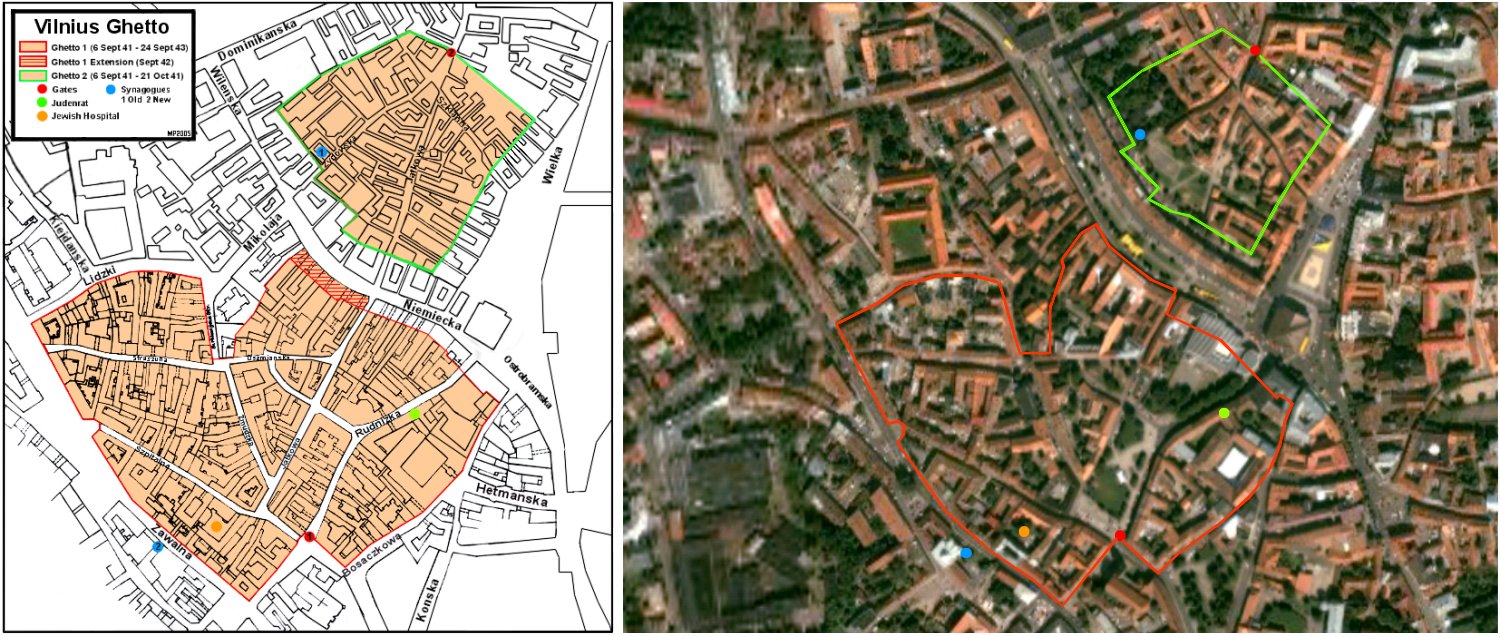
I haven't started the book yet, though it looks terrific. The reason I was distracted from beginning was because I was drawn into the map on the inside cover of the Vilna Ghetto. I tried to locate our apartment on the map, and after several minutes of comparing maps and looking online, I learned the chilling fact that our living room window, which currently looks out onto a grassy area where children are currently playing, 69 years ago would have looked into the Ghetto itself.

Take a look at this map. You'll see two ghettoes outlined and a street called Niemiecka dividing them. Today, that street is called Vokiečių and is the street where we currently live. If you look at the Google Map image on the right, you'll see on the street between the two outlined areas a yellow blotch - that's an outdoor eating area near us. Our apartment is a bit to the right, looking north into the area outlined in green.

Jessica wrote in the last post that it is easy to feel the sorrow when walking past certain monuments and museums. Learning about where exactly we live now provides a different experience, an eerie sense of near-death that we might look out our window slightly further to the left and see not a woman coming home with her groceries but a Jewish woman with no food to eat.

Lithuania was a battleground between Poland, Germany, and the Soviet Union before and during WWII, and the fact that the country has been able to progress from that fought-over piece of territory through the years of Soviet control to arrive at the modern state that it is amazes me. I can't blame Lithuania for wanting to distance itself from its war-torn path. But I hope that Lithuania will forgive me for spending a bit of my summer in the past, remembering and mourning the glorious Jewish community that was snuffed out less than seventy years ago.

We'll never get the "Jerusalem of Lithuania" back, but I'm grateful to be in Vilnius taking part in the revival of Yiddish language, literature, and culture, which flourished so brightly here. I'm exceedingly proud of Jessica and others in her field who make this revival their life work, and I look forward to learning from them for a month. As we remember the tragedies of the past, I hope we will also be able to recovery the joys of lost generations in our own lives.

Visiting Vilnius!

For all of you loyal followers of our previous blog, Journaling in Jerusalem, you will note that we both like alliteration and enjoy studying abroad. So, once again, we are combining these two pleasures, and we proudly present: Visiting Vilnius, a blog about our experiences for our month in Lithuania, studying at the Vilnius Yiddish Institute.

We are living in a large and beautiful apartment in the old part of the city, not far from the university. Our windows face a small park, and the front of the building faces a large street full of restaurants and shopping. Vilnius is a colorful city with comfortably large buildings of a variety of colors, wide streets, and, at least for this time of year, hot and sunny weather tempered by occasional breezes.

We arrived in the afternoon yesterday and spent some time getting our bearings, walking around tourist shops and enormous beautiful churches, finding a grocery store, and learning how to use our appliances before cooking a healthy Shabbat dinner and basking in the at-home-ness of finally settling down after over a month of travels to a place that we can call ours for the time being.

In the morning, we set out to a supermarket to find some much-needed tupperware. It was a long walk, and gave us an opportunity to view the city in greater detail. We walked past the university and through the lazy Saturday morning in the city, bought ourselves beet salad and chick pea salad at the grocery store and sat on the steps to enjoy the refreshment. We are learning how to make change, how to say thank you (ačiū, pronounced "achoo"), and most importantly, we are becoming fluent in clumsy traveler's sign language. We walked up a long flight of stairs to a large building where the collector's club sells their wares on Saturdays. This was an antique market filled with gems such as a spinning wheel and old fashioned clothes irons, keys, stamps, coins, nick knacks of every shape and size. It stretched around the Trade Union palace, and we caught the spare end of the market, walking around to watch people pack away their portraits of Lenin, AC DC records, and chess boards. On our walk, we passed the Choral synagogue, which was built in 1903 and is the only synagogue remaining in a city that once boasted over 100 Jewish places of worship. We then walked back through the city and made our way to Hales Market, a tame version of Jerusalem's shuk. At the front of the market is a glass covered area with stalls selling women's underwear, shoes, and out of fashion clothing. At its center is a large brick building with fruit, meat, and cheese stalls and bakeries. We bought bundles of green onion for under a dollar, tasted lots of terrific honey, and purchased some sweets.

On our walk home, we stumbled upon a sign indicating that we were at the spot where once had stood the watch tower of the Vilna Ghetto, where over the course of a few days, thousands upon thousands of Jews were murdered. This area, which is right next to where we live, was a sobering reminder of the ghosts that haunt this beautiful and peaceful city, where we have come to learn a language that once graced these streets, but now is heard no more.

We're happy and proud to be living and studying here for a full month, and we look forward to sharing the vibrancy of this eastern European city with readers around the world. We'll be sharing pictures soon, and we look forward to our next update. Thanks for visiting Visiting Vilnius!