We arrived in Vilnius last Friday afternoon and made a modest Shabbat for just the two of us. Now, after a full week, we had a chance to expand our Shabbat experience - and we've had a really terrific time!
On Friday afternoon, Jessica went on a group tour of the Vilna Gaon Jewish State Museum, which highlights Jewish life in Vilnius before World War II and during the Holocaust. I toured this museum on Tuesday in English; Jessica's tour was given by an 88-year-old former partisan named Fania Brantsovskaya. Her tour was incredibly moving as Fania shared personal stories about individuals depicted in photographs documenting the atrocities of the Shoah. The first picture one sees when walking into the museum is a large family portrait - Fania shared that only she and her cousin survived the war. Now, Fania passes her story on to new generations of students and rememberers.
Fortunately, we were able to lighten the mood after this heavy experience. Jessica and I collaborated on making a delicious Shabbat dinner (perfect challahs, caprese salad, spinach salad, bean pie, and watermelon for dessert), to which we invited our two friends from New York, Julie and Bengy. The four of us then proceeded to the Shabbes tisch (table), where members of our program gathered to share snacks and sing Yiddish songs in celebration of Shabbat. Two groups of students and teachers led the singing, almost entirely in Yiddish, and though not everyone understood what was going on, everyone seemed to love being with one another outside the classroom with nothing but good company and warm food to occupy us.
Today (Saturday), Jessica and I went to the Choral Synagogue. Built in 1903, this is the only one (out of more than 100) synagogues in Vilnius still standing, having survived both WWII and Soviet governorship. The community is, as it has always been, orthodox in its inclination, so Jessica and I were not able to sit together during services (as was expected). Though separated, we were warmly welcomed by those around us, and the beautiful singing of the service leaders conducted us through a service that is familiar to me even across boundaries of distance and ideology.
Congregants spoke to one another primarily in Yiddish, and when one congregant asked me Bistu Kohen, Levi... I knew to answer Yisroel. I was invited to give the fourth Torah blessing, which I tried my best to deliver with the Ashkenazic pronunciation of Hebrew that is customary in this conversation. The other men at the Torah scroll were warm and supportive, and I felt more comfortable than ever before in an orthodox congregation.
Unfortunately, my comfort and the comfort of those around me was disrupted by an apparently ultra-orthodox man who (it seems to us) makes a point of attending this synagogue even though it's not "his" community. After the sermon, which was delivered in Yiddish, this black-suited, long-bearded man ascended the bima and was immediately met with angry shouts to sit back down. The man ignored them and at the top of his voice, welcomed the visitors in the congregation to Vilnius (the only part of what he said that I understood as he was saying it). He then proceeded (as Jessica translated for me later) to berate the community for its poor observance.
His tirade became more and more emphatic, and at one point, a member of the congregation started arguing with him. After a couple minutes, most of the men walked out of the sanctuary; not long after, this man took his leave from the bima (though he remained in the sanctuary, continuing as he had the whole service to speak to people rudely using his "outside voice"). It was a real shame that he brought his bitterness and judgment to this community on Shabbat. Though he lamented the poor observance being displayed before visitors, truly he was the one being unwelcoming to foreigners.
The community soon recovered from its shock and anger, concluding the service as normal. Congregants bid one another a gut Shabbes and departed, turning off lights and closing down the windows as they left. (This, of course, caused the vociferous interloper to loudly declaim the congregants' poor observance on his way out of the synagogue.) Jessica and I said our good-byes and came home to enjoy once again last night's dinner food.
In the afternoon, Jessica and I visited two Vilnius sites. First, we traveled to Gediminas' Tower, whose history stretches back to the beginning of the fifteenth century. From the top of this old fortress, we had a great 360° view of Vilnius; we could see the huge cathedrals and small houses, the centuries-old Old City and the stark buildings from the Communist Era, the busy skyscrapers and the peaceful forest. It was amazing to have such a perspective on where we live, reminding us of how little we've seen in the week that we've been here.
We left the castle and walked through the business district of the city, replete with tall hotels, taller banks, a shopping mall and a casino! We visited the National Gallery of Art, which contained twelve large rooms full of an array of works created by Lithuanian artists over the past hundred years or so. Highlighted currently were several exhibits of artwork involving women, accompanied by explanatory signs that interpreted the use of women in ancient art, Soviet propaganda, and modern media. The art was really terrific, and there was so much that we couldn't see it all before becoming too exhausted to stay.
On our way home, we passed a small area near the river that seems to be a mini-fair. There were bumper cars and bumper boats, a huge bouncy-castle, several beach volleyball courts, and a skateboarding/biking plaza. Even better (for us), we stumbled upon Mano Guru, a salad restaurant with 1/3 of its meals vegetarian friendly! I enjoyed a tall glass of "cowberry"-pear juice, while Jessica drank some interesting hot tea, and we dined on delicious salads before topping off the meal with a piece of chocolate cake with cherries and vanilla ice cream (all for the equivalent of $15). What a find!
Tomorrow, we have a field trip with the program that will take us into the heart of Holocaust remembrance. We anticipate that the day will be very hard, though we're going to try to relate what we experience here on the blog. For now, though, we're still appreciating the beauty of our Shabbat, and we're looking forward to another expanding and engaging week of courses!
Saturday, July 31, 2010

Wednesday, July 28, 2010
Yesterday's Lecture
Yesterday afternoon, we had the opportunity to hear Fira Bramson, the director emeritus of Judaica at the Lithuanian National Library, speak about the destruction and reconstruction of Jewish libraries in Vilnius. She spoke in Yiddish, and one of the professors from the program translated her words into English.
Before the war, Jews made up a third of Vilnius's population and Vilnius was a major center for publishing and printing books, including the religious books that were used throughout Eastern Europe. By the 1820's Rohm's publishing house was already publishing secular literature in the form of booklets of stories for women. Kletske press, one of the largest Jewish presses in Europe, published translations of world literature into Yiddish, children's literature, and textbooks, as well as classic Yiddish writers and new up-and-coming writers, including the group of writers known as Yung Vilna. The Tomer publishing house published scientific works. Later, Warsaw became the center of publishing but the printing itself continued to happen in Vilna. Fira mentioned that the Lithuanian National Library has selections from these scientific volumes, which were selected not by people but by the mere fact of their survival during the war, just like the people who remained after the war. There were four major Jewish libraries in Vilna before the war, the largest of which contained 15,000 volumes. The Yivo Institute for Jewish Studies was begun in Vilna, first out of the apartment of its founder, Max Weinreich and later in a new apartment, and finally, for 13 years, in its own building, which was built with funds raised from Jews around the world. In 1944 the building was destroyed by a bomb. Yivo was a major factor in the Jewish world, which connected itself to the people and collected important artifacts, some of which were saved and sent to Yivo when it relocated to New York.
When Jews were forced to enter the ghetto, many of them smuggled in their books, so that they managed to bring 1000 books into the ghetto and start a library there. The library was a cultural center for the ghetto. In 1941 the gestapo sent all of the books in Vilna to the Yivo building to be sorted - the most important were to be sent Frankfurt Germany's Nazi Institute for the Research into the Jewish Question. Seventy percent of the books were to be disposed of. The famous "paper brigade," a work group of twelve poets and writers, that was forced to sort through this literature, hid as much of it as they could, smuggling books into the ghetto, where they were stored in private homes, cellars, and the ghetto library.
After the war, the partisans who had left the ghetto through the sewage system came back to find the books and gather them into an exhibit on the cultural life and preservation of the human spirit in the ghetto. The Soviet government was not interested in displaying the exhibit and sent the materials from it to various institutes - it was never reassembled. During the Soviet years, Jewish life and expression was suppressed, and very little could be done with all of the Jewish books and materials that had been saved, They sat in a church, and in 1989, Fira and others were finally able to access the material and sort through it, finding papers from Yivo archives, newspapers, and kilos and kilos of books. Copies of some of this material was sent to Yivo in New York, but much of it can only be found in Vilnius. The catalogue for the library's holdings is undergoing digitization, so that the world will be able to see that in Vilnius they have 10,000 first editions, and copies of newspapers from the 1920's and 1930's that don't exist anywhere else.
Fira said that the fact that these materials were saved through all of the traumatic events of the 20th century, and the fact that when people could finally access them there were still people around who understood the significance of the materials and could read them is a miracle.
It was an honor to hear from a Jewish activist so dedicated to preserving the written material, the words and writings that bear witness to a Jewish world that was almost completely lost. In her retirement, Fira wrote a book of essays and thoughts about her work with the library, which was published in Lithuanian and Yiddish - I have a copy of it now and look forward to reading it!
This interesting newspaper article from 1996 discusses the precarious position of the materials from the library not so long ago.
Before the war, Jews made up a third of Vilnius's population and Vilnius was a major center for publishing and printing books, including the religious books that were used throughout Eastern Europe. By the 1820's Rohm's publishing house was already publishing secular literature in the form of booklets of stories for women. Kletske press, one of the largest Jewish presses in Europe, published translations of world literature into Yiddish, children's literature, and textbooks, as well as classic Yiddish writers and new up-and-coming writers, including the group of writers known as Yung Vilna. The Tomer publishing house published scientific works. Later, Warsaw became the center of publishing but the printing itself continued to happen in Vilna. Fira mentioned that the Lithuanian National Library has selections from these scientific volumes, which were selected not by people but by the mere fact of their survival during the war, just like the people who remained after the war. There were four major Jewish libraries in Vilna before the war, the largest of which contained 15,000 volumes. The Yivo Institute for Jewish Studies was begun in Vilna, first out of the apartment of its founder, Max Weinreich and later in a new apartment, and finally, for 13 years, in its own building, which was built with funds raised from Jews around the world. In 1944 the building was destroyed by a bomb. Yivo was a major factor in the Jewish world, which connected itself to the people and collected important artifacts, some of which were saved and sent to Yivo when it relocated to New York.
When Jews were forced to enter the ghetto, many of them smuggled in their books, so that they managed to bring 1000 books into the ghetto and start a library there. The library was a cultural center for the ghetto. In 1941 the gestapo sent all of the books in Vilna to the Yivo building to be sorted - the most important were to be sent Frankfurt Germany's Nazi Institute for the Research into the Jewish Question. Seventy percent of the books were to be disposed of. The famous "paper brigade," a work group of twelve poets and writers, that was forced to sort through this literature, hid as much of it as they could, smuggling books into the ghetto, where they were stored in private homes, cellars, and the ghetto library.
After the war, the partisans who had left the ghetto through the sewage system came back to find the books and gather them into an exhibit on the cultural life and preservation of the human spirit in the ghetto. The Soviet government was not interested in displaying the exhibit and sent the materials from it to various institutes - it was never reassembled. During the Soviet years, Jewish life and expression was suppressed, and very little could be done with all of the Jewish books and materials that had been saved, They sat in a church, and in 1989, Fira and others were finally able to access the material and sort through it, finding papers from Yivo archives, newspapers, and kilos and kilos of books. Copies of some of this material was sent to Yivo in New York, but much of it can only be found in Vilnius. The catalogue for the library's holdings is undergoing digitization, so that the world will be able to see that in Vilnius they have 10,000 first editions, and copies of newspapers from the 1920's and 1930's that don't exist anywhere else.
Fira said that the fact that these materials were saved through all of the traumatic events of the 20th century, and the fact that when people could finally access them there were still people around who understood the significance of the materials and could read them is a miracle.
It was an honor to hear from a Jewish activist so dedicated to preserving the written material, the words and writings that bear witness to a Jewish world that was almost completely lost. In her retirement, Fira wrote a book of essays and thoughts about her work with the library, which was published in Lithuanian and Yiddish - I have a copy of it now and look forward to reading it!
This interesting newspaper article from 1996 discusses the precarious position of the materials from the library not so long ago.
Tuesday, July 27, 2010
Second Day of Class
In the Vilnius summer Yiddish program, students are divided into four levels, and each level has language classes with two different teachers, with a generous coffee break (coffee and tea provided) between them. In the afternoon there are study sessions and supplemental cultural educational activities, and every Sunday there is a field trip.
My class, level 4, consists of eleven students, including myself. Four are young female graduate students from the US, Poland, France, and Lithuania, two are middle aged women who work for YIVO, the Jewish scholarship institute, in Buenos Aires, two are middle aged women from Israel with some previous involvement with Beit Sholem Aleichem, a Yiddish organization in Tel Aviv, one is an actress and translator from Vancouver, one is a professor of Dutch language who teaches in Helsinki, Finland, and one is a man born in Czcheckloslovakia, who lives in the Netherlands and is engaged in the process of formal Orthodox conversion to Judaism. We are a geographically and experientially diverse class, but our Yiddish is roughly on the same level, so we are able to have interestig conversations about the poetry and literature that we read together.
Our first class is taught by Abraham Lichtenbaum, who is the executive director of YIVO in Buenos Aires. He is a funny and dynamic teacher, patient, provocative, and insistent on class discussion rather than lecture. In his class we are reading The Dybbuk, perhaps the most famous play ever written in Yiddish. It was written in 1914 by Sh. Ansky, a folklorist who went on expeditions to research the way of life and culture of Jewish communities in Eastern Europe. It is a passionate, mystical, spooky piece, and I am really looking forward to exploring it with this class. Yesterday Professor Lichtenbaum lectured us on Jewish folk practices and superstitions to prepare us for the piece, and today we will start talking about the play itself.
Our second class is taught by Dov Ber Kerler, who teaches at Indiana University. He has high expectations for our class, speaking Yiddish very fast and antipating that we will read and write quite a lot over the course of the month. He begins class each day with a poem that we listen to on his computer so that we can hear the poet's actual voice. Then, we go on to read and discuss a work of literature. Right now we are reading Yaknehoz, a comedy about the absurdity and vulgarity of Jews involved in the stock exchange in Odessa. The print is small, and Sholem Aleichem was known for his nuanced representation of the spoken word, so that the text was certainly not constructed for students but for people who could pick up on the slavic expressions and cultural references. Nevertheless, from what I can understand of the play, it is a doozie!
It appears that each week we will write two short essays for Professer Lichtenbaum and two longer essays for Professor Kerler, and we will take turns giving presentations as well. It does seem manageable though, as we have afternoons and evenings to ourselves to prepare the homework.
On the first day of class we read a poem which I really enjoyed and thought was interesting, so I'll share it with you here:
To Be a Jew
To be a Jew means always running after God,
Even if you are turning away;
Sitting and waiting for an unknown day
(Even if you are a non-believer)
When you will hear the sound of the Messiah's shofar
To be a Jew means not being able to get away from God
Even if you want to;
Not being able to stop saying prayers
Even after all the prayers have been said,
Even after all of the excuses have been made.
-Aaron Zeitlin
And one more, for good measure:
The Jewish People
Zionists want all of the Jews,
Communists want all of the Jews,
Socialists want all of the Jews,
Anarchists want all of the Jews.
Everyone - wants all of the Jews.
The people says:
Slow down...
Just as the world is - so am I,
Says the people.
And how is the world? This is how the world is.
A bit of earth, a bit of water,
A bit of wind, a bit of fire,
The rest - sand.
And so am I - says the people
Like the world.
A bit of Zionism,
A touch of Communism
A spray of Socialism
A breath of Anarchism
The rest - sand.
Made up of all these little pieces - says the people
Just like the world - so am I.
What a shame it would be if the world was made
Of only fire, only water,
Only earth, only wind.
A bit of Yiddish, a bit of Hebrew,
A bit of religion, as bit of secularism,
The rest - sand.
The Jewish people is as old as the world,
And as wise as the world.
My class, level 4, consists of eleven students, including myself. Four are young female graduate students from the US, Poland, France, and Lithuania, two are middle aged women who work for YIVO, the Jewish scholarship institute, in Buenos Aires, two are middle aged women from Israel with some previous involvement with Beit Sholem Aleichem, a Yiddish organization in Tel Aviv, one is an actress and translator from Vancouver, one is a professor of Dutch language who teaches in Helsinki, Finland, and one is a man born in Czcheckloslovakia, who lives in the Netherlands and is engaged in the process of formal Orthodox conversion to Judaism. We are a geographically and experientially diverse class, but our Yiddish is roughly on the same level, so we are able to have interestig conversations about the poetry and literature that we read together.
Our first class is taught by Abraham Lichtenbaum, who is the executive director of YIVO in Buenos Aires. He is a funny and dynamic teacher, patient, provocative, and insistent on class discussion rather than lecture. In his class we are reading The Dybbuk, perhaps the most famous play ever written in Yiddish. It was written in 1914 by Sh. Ansky, a folklorist who went on expeditions to research the way of life and culture of Jewish communities in Eastern Europe. It is a passionate, mystical, spooky piece, and I am really looking forward to exploring it with this class. Yesterday Professor Lichtenbaum lectured us on Jewish folk practices and superstitions to prepare us for the piece, and today we will start talking about the play itself.
Our second class is taught by Dov Ber Kerler, who teaches at Indiana University. He has high expectations for our class, speaking Yiddish very fast and antipating that we will read and write quite a lot over the course of the month. He begins class each day with a poem that we listen to on his computer so that we can hear the poet's actual voice. Then, we go on to read and discuss a work of literature. Right now we are reading Yaknehoz, a comedy about the absurdity and vulgarity of Jews involved in the stock exchange in Odessa. The print is small, and Sholem Aleichem was known for his nuanced representation of the spoken word, so that the text was certainly not constructed for students but for people who could pick up on the slavic expressions and cultural references. Nevertheless, from what I can understand of the play, it is a doozie!
It appears that each week we will write two short essays for Professer Lichtenbaum and two longer essays for Professor Kerler, and we will take turns giving presentations as well. It does seem manageable though, as we have afternoons and evenings to ourselves to prepare the homework.
On the first day of class we read a poem which I really enjoyed and thought was interesting, so I'll share it with you here:
To Be a Jew
To be a Jew means always running after God,
Even if you are turning away;
Sitting and waiting for an unknown day
(Even if you are a non-believer)
When you will hear the sound of the Messiah's shofar
To be a Jew means not being able to get away from God
Even if you want to;
Not being able to stop saying prayers
Even after all the prayers have been said,
Even after all of the excuses have been made.
-Aaron Zeitlin
And one more, for good measure:
The Jewish People
Zionists want all of the Jews,
Communists want all of the Jews,
Socialists want all of the Jews,
Anarchists want all of the Jews.
Everyone - wants all of the Jews.
The people says:
Slow down...
Just as the world is - so am I,
Says the people.
And how is the world? This is how the world is.
A bit of earth, a bit of water,
A bit of wind, a bit of fire,
The rest - sand.
And so am I - says the people
Like the world.
A bit of Zionism,
A touch of Communism
A spray of Socialism
A breath of Anarchism
The rest - sand.
Made up of all these little pieces - says the people
Just like the world - so am I.
What a shame it would be if the world was made
Of only fire, only water,
Only earth, only wind.
A bit of Yiddish, a bit of Hebrew,
A bit of religion, as bit of secularism,
The rest - sand.
The Jewish people is as old as the world,
And as wise as the world.
Monday, July 26, 2010
First day of class
Today was our first day of classes at the Yiddish Institute - certainly a change of pace from our honeymoon in Italy! There are 12 students in my Yiddish 1 class and about 10 in Jessica's Yiddish 4 class, and these students are from all around the world (England, Canada, Israel, Germany, Lithuania, Poland, etc.). In Yiddish 1, we reviewed the alphabet (alef-beis) and in Yiddish 4, Jessica's class went over several Yiddish poems (you can see the difference, can't you?). My homework: Write three sentences. Jessica's homework: Write three pages (though she has one extra day). Let's just say I'm glad I'm in my own class!
This afternoon, we watched a film called Ivan and Abraham, which depicted Jewish-Polish relations in the 1930s. I thought the acting was a bit flat, but the imagery and character development were fascinating, giving a taste of pre-WWII life for Jews and non-Jews alike (or at least the retrospective view of that life from the early 1990s). This is the first of several films that we'll be viewing, and I'm as excited to see the content as to learn about the perspective of the filmmakers that gave birth to these stories. More on those as we get to them!
I'm very impressed by the other students that I've met. Most I've spoken with do not identify as Jewish but are nonetheless interested in studying Jewish language, culture, and history. Students have come for any number of reasons with such a variety of stories - I'm endlessly interested to learn each person's story and to see the world though his or her eyes. I'm so looking forward to getting to know everyone better!
This afternoon, we watched a film called Ivan and Abraham, which depicted Jewish-Polish relations in the 1930s. I thought the acting was a bit flat, but the imagery and character development were fascinating, giving a taste of pre-WWII life for Jews and non-Jews alike (or at least the retrospective view of that life from the early 1990s). This is the first of several films that we'll be viewing, and I'm as excited to see the content as to learn about the perspective of the filmmakers that gave birth to these stories. More on those as we get to them!
I'm very impressed by the other students that I've met. Most I've spoken with do not identify as Jewish but are nonetheless interested in studying Jewish language, culture, and history. Students have come for any number of reasons with such a variety of stories - I'm endlessly interested to learn each person's story and to see the world though his or her eyes. I'm so looking forward to getting to know everyone better!
Sunday, July 25, 2010
Day One of the Yiddish Program
This morning we made our way through the former Jewish quarter of Vilnius, down Zydo Gavte (Jewish Street) to Vilnius University, where we entered the Vilnius Yiddish Institute to register for the program. We met friends of ours from New York there, Julie and Benjy, encountered a friend of mine from my internship at the National Yiddish Book Center, and set about to chatting and becoming aquainted with folks. We were impressed by the age and geographical range of the participants - we appear to be among the younger students, though there are a healthy number of students about our age, and the students come from 18 different countries including Israel, Finland, Italy, Belgium, Holland, Lithuania, Britain, and Canada. After registering, we took a walk and ended up in a coffee shop to read our books, where I ordered a magnificent coffee with melted chocolate on the bottom. The program reconvened at a restaurant close to the University, where we heard brief opening remarks reminding us of the weighty joy that the organizers feel in continuing Yiddish in the city that came to symbolize the language and its literature and scholarship. We heard from organizors as well as some members of the Lithuanian Jewish community. Also, our friend Benjy, a talented Yiddish musician who will be leading music sessions during the program performed some songs about food. Then, we ate some delicious food while talking to participants in the program, all of whom seem very friendly and interesting - I think the relationships we form here with other participants will be highlites of the experience. On our walk home we stopped in a museum of contemporary art, where we saw work from the Fluxus Movement, as well as some terrific international artwork, including a jarring exhibit on the Virginia Tech shootings, which I was surprised to be viewing so far away from home.
Tomorrow morning we begin classes at 9:30 AM - can't wait to tell you all about them.
In the meantime, check out some pictures of our visit here.
Tomorrow morning we begin classes at 9:30 AM - can't wait to tell you all about them.
In the meantime, check out some pictures of our visit here.
Saturday, July 24, 2010
Rebuilding on the remnants of the past
Today, I started a new book recommended to us by a rabbi who works at HUC in Jerusalem. The book is called From that Place and Time, and it's a memoir about the Vilna Ghetto. Wikipedia's opening paragraph about the ghetto provides a good summary of the significance of this area:
The Vilna Ghetto, Wilno Ghetto or Vilnius Ghetto was a Jewish ghetto established by Nazi Germany in the city of Vilnius, during the Holocaust in World War II. During roughly two years of its existence, starvation, disease, street executions, maltreatment and deportations to concentration camps and extermination camps reduced the population of the ghetto from an estimated 40,000 to zero. Only several hundred people managed to survive, mostly by hiding in the forests surrounding the town, joining the Soviet partisans or finding shelter among sympathetic locals.
I haven't started the book yet, though it looks terrific. The reason I was distracted from beginning was because I was drawn into the map on the inside cover of the Vilna Ghetto. I tried to locate our apartment on the map, and after several minutes of comparing maps and looking online, I learned the chilling fact that our living room window, which currently looks out onto a grassy area where children are currently playing, 69 years ago would have looked into the Ghetto itself.
Take a look at this map. You'll see two ghettoes outlined and a street called Niemiecka dividing them. Today, that street is called Vokiečių and is the street where we currently live. If you look at the Google Map image on the right, you'll see on the street between the two outlined areas a yellow blotch - that's an outdoor eating area near us. Our apartment is a bit to the right, looking north into the area outlined in green.
Jessica wrote in the last post that it is easy to feel the sorrow when walking past certain monuments and museums. Learning about where exactly we live now provides a different experience, an eerie sense of near-death that we might look out our window slightly further to the left and see not a woman coming home with her groceries but a Jewish woman with no food to eat.
Lithuania was a battleground between Poland, Germany, and the Soviet Union before and during WWII, and the fact that the country has been able to progress from that fought-over piece of territory through the years of Soviet control to arrive at the modern state that it is amazes me. I can't blame Lithuania for wanting to distance itself from its war-torn path. But I hope that Lithuania will forgive me for spending a bit of my summer in the past, remembering and mourning the glorious Jewish community that was snuffed out less than seventy years ago.
We'll never get the "Jerusalem of Lithuania" back, but I'm grateful to be in Vilnius taking part in the revival of Yiddish language, literature, and culture, which flourished so brightly here. I'm exceedingly proud of Jessica and others in her field who make this revival their life work, and I look forward to learning from them for a month. As we remember the tragedies of the past, I hope we will also be able to recovery the joys of lost generations in our own lives.
Take a look at this map. You'll see two ghettoes outlined and a street called Niemiecka dividing them. Today, that street is called Vokiečių and is the street where we currently live. If you look at the Google Map image on the right, you'll see on the street between the two outlined areas a yellow blotch - that's an outdoor eating area near us. Our apartment is a bit to the right, looking north into the area outlined in green.
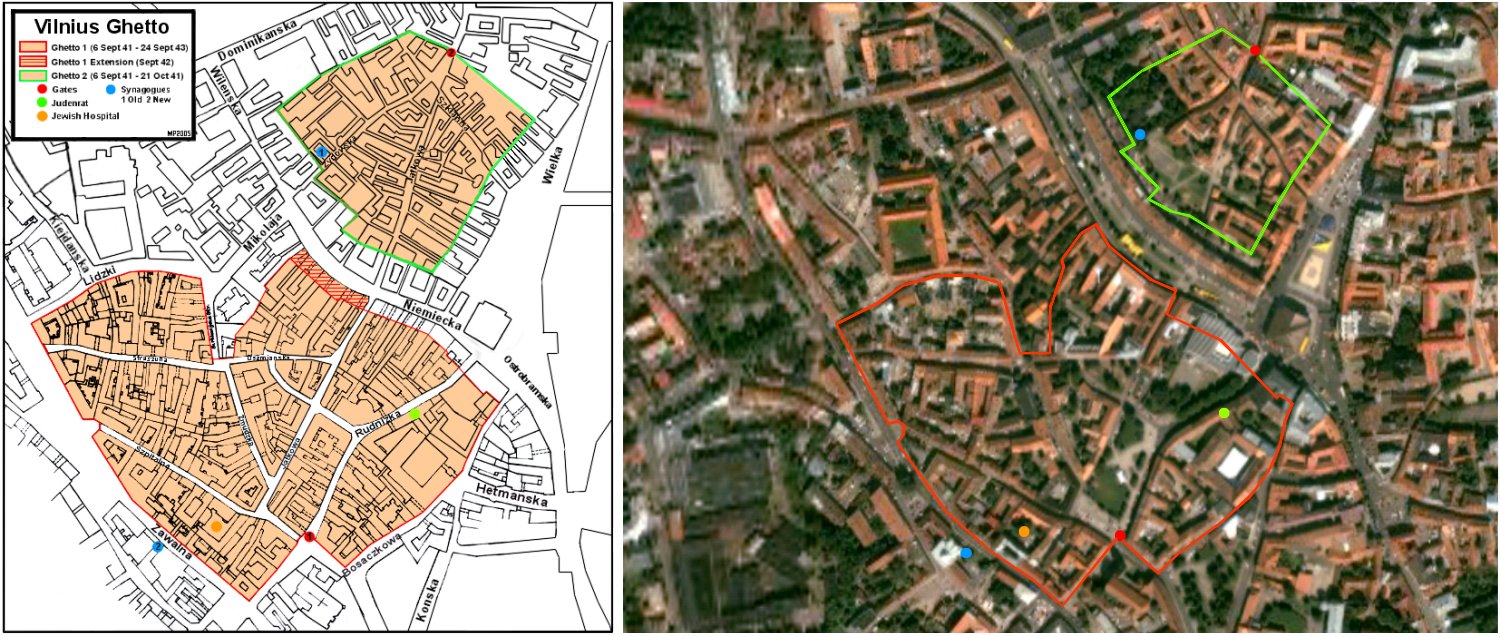
Jessica wrote in the last post that it is easy to feel the sorrow when walking past certain monuments and museums. Learning about where exactly we live now provides a different experience, an eerie sense of near-death that we might look out our window slightly further to the left and see not a woman coming home with her groceries but a Jewish woman with no food to eat.
Lithuania was a battleground between Poland, Germany, and the Soviet Union before and during WWII, and the fact that the country has been able to progress from that fought-over piece of territory through the years of Soviet control to arrive at the modern state that it is amazes me. I can't blame Lithuania for wanting to distance itself from its war-torn path. But I hope that Lithuania will forgive me for spending a bit of my summer in the past, remembering and mourning the glorious Jewish community that was snuffed out less than seventy years ago.
We'll never get the "Jerusalem of Lithuania" back, but I'm grateful to be in Vilnius taking part in the revival of Yiddish language, literature, and culture, which flourished so brightly here. I'm exceedingly proud of Jessica and others in her field who make this revival their life work, and I look forward to learning from them for a month. As we remember the tragedies of the past, I hope we will also be able to recovery the joys of lost generations in our own lives.
Visiting Vilnius!
For all of you loyal followers of our previous blog, Journaling in Jerusalem, you will note that we both like alliteration and enjoy studying abroad. So, once again, we are combining these two pleasures, and we proudly present: Visiting Vilnius, a blog about our experiences for our month in Lithuania, studying at the Vilnius Yiddish Institute.
We are living in a large and beautiful apartment in the old part of the city, not far from the university. Our windows face a small park, and the front of the building faces a large street full of restaurants and shopping. Vilnius is a colorful city with comfortably large buildings of a variety of colors, wide streets, and, at least for this time of year, hot and sunny weather tempered by occasional breezes.
We arrived in the afternoon yesterday and spent some time getting our bearings, walking around tourist shops and enormous beautiful churches, finding a grocery store, and learning how to use our appliances before cooking a healthy Shabbat dinner and basking in the at-home-ness of finally settling down after over a month of travels to a place that we can call ours for the time being.
In the morning, we set out to a supermarket to find some much-needed tupperware. It was a long walk, and gave us an opportunity to view the city in greater detail. We walked past the university and through the lazy Saturday morning in the city, bought ourselves beet salad and chick pea salad at the grocery store and sat on the steps to enjoy the refreshment. We are learning how to make change, how to say thank you (ačiū, pronounced "achoo"), and most importantly, we are becoming fluent in clumsy traveler's sign language. We walked up a long flight of stairs to a large building where the collector's club sells their wares on Saturdays. This was an antique market filled with gems such as a spinning wheel and old fashioned clothes irons, keys, stamps, coins, nick knacks of every shape and size. It stretched around the Trade Union palace, and we caught the spare end of the market, walking around to watch people pack away their portraits of Lenin, AC DC records, and chess boards. On our walk, we passed the Choral synagogue, which was built in 1903 and is the only synagogue remaining in a city that once boasted over 100 Jewish places of worship. We then walked back through the city and made our way to Hales Market, a tame version of Jerusalem's shuk. At the front of the market is a glass covered area with stalls selling women's underwear, shoes, and out of fashion clothing. At its center is a large brick building with fruit, meat, and cheese stalls and bakeries. We bought bundles of green onion for under a dollar, tasted lots of terrific honey, and purchased some sweets.
On our walk home, we stumbled upon a sign indicating that we were at the spot where once had stood the watch tower of the Vilna Ghetto, where over the course of a few days, thousands upon thousands of Jews were murdered. This area, which is right next to where we live, was a sobering reminder of the ghosts that haunt this beautiful and peaceful city, where we have come to learn a language that once graced these streets, but now is heard no more.
We're happy and proud to be living and studying here for a full month, and we look forward to sharing the vibrancy of this eastern European city with readers around the world. We'll be sharing pictures soon, and we look forward to our next update. Thanks for visiting Visiting Vilnius!
We are living in a large and beautiful apartment in the old part of the city, not far from the university. Our windows face a small park, and the front of the building faces a large street full of restaurants and shopping. Vilnius is a colorful city with comfortably large buildings of a variety of colors, wide streets, and, at least for this time of year, hot and sunny weather tempered by occasional breezes.
We arrived in the afternoon yesterday and spent some time getting our bearings, walking around tourist shops and enormous beautiful churches, finding a grocery store, and learning how to use our appliances before cooking a healthy Shabbat dinner and basking in the at-home-ness of finally settling down after over a month of travels to a place that we can call ours for the time being.
In the morning, we set out to a supermarket to find some much-needed tupperware. It was a long walk, and gave us an opportunity to view the city in greater detail. We walked past the university and through the lazy Saturday morning in the city, bought ourselves beet salad and chick pea salad at the grocery store and sat on the steps to enjoy the refreshment. We are learning how to make change, how to say thank you (ačiū, pronounced "achoo"), and most importantly, we are becoming fluent in clumsy traveler's sign language. We walked up a long flight of stairs to a large building where the collector's club sells their wares on Saturdays. This was an antique market filled with gems such as a spinning wheel and old fashioned clothes irons, keys, stamps, coins, nick knacks of every shape and size. It stretched around the Trade Union palace, and we caught the spare end of the market, walking around to watch people pack away their portraits of Lenin, AC DC records, and chess boards. On our walk, we passed the Choral synagogue, which was built in 1903 and is the only synagogue remaining in a city that once boasted over 100 Jewish places of worship. We then walked back through the city and made our way to Hales Market, a tame version of Jerusalem's shuk. At the front of the market is a glass covered area with stalls selling women's underwear, shoes, and out of fashion clothing. At its center is a large brick building with fruit, meat, and cheese stalls and bakeries. We bought bundles of green onion for under a dollar, tasted lots of terrific honey, and purchased some sweets.
On our walk home, we stumbled upon a sign indicating that we were at the spot where once had stood the watch tower of the Vilna Ghetto, where over the course of a few days, thousands upon thousands of Jews were murdered. This area, which is right next to where we live, was a sobering reminder of the ghosts that haunt this beautiful and peaceful city, where we have come to learn a language that once graced these streets, but now is heard no more.
We're happy and proud to be living and studying here for a full month, and we look forward to sharing the vibrancy of this eastern European city with readers around the world. We'll be sharing pictures soon, and we look forward to our next update. Thanks for visiting Visiting Vilnius!
Subscribe to:
Comments (Atom)